
AI Video Monitoring Transforms Facility Management

Since video monitoring technology became standard in facilities, it has largely been viewed as a security tool. Cameras recorded events, security personnel reviewed footage after incidents occurred, and the primary goal was deterrence and investigation.
Over the last few years, and for the foreseeable future, the role of video systems in facilities is expanding dramatically.
Part of the shift is thanks to advances in artificial intelligence (AI), which is transforming video systems from passive recording devices into active operational tools. AI-enabled camera systems can be more than static security and post-incident tools for facilities by proactively helping to:
- Identify potential safety issues.
- Monitor critical processes.
- Support maintenance programs.
- Speed up response time for developing problems.
As facilities continue to face pressure to improve efficiency, reduce downtime, and operate with leaner staffing levels, AI-powered video monitoring is becoming a cost-effective source of operational intelligence.
Video for Operational Awareness
Video systems generate enormous amounts of footage, but most of it is never reviewed unless something goes wrong. AI changes that by automatically analyzing video streams and identifying events that matter.
Rather than requiring personnel to watch dozens or hundreds of camera feeds, AI can continuously monitor for specific conditions and notify staff when action is needed.
Many of today’s AI-enabled systems can identify activities such as:
- Unauthorized entry into restricted areas.
- Personnel crossing safety boundaries.
- Objects being removed from designated locations.
- Cameras being obstructed or tampered with.
- Vehicle activity in sensitive areas.
These capabilities allow facility teams to focus on exceptions rather than continuously monitoring routine activity. In manufacturing facilities, warehouses, healthcare campuses, commercial properties, and other facilities, AI video analysis can improve situational awareness while reducing the burden on security and operations personnel.
Uses for AI Video in Facilities
One of the most significant trends in facility management is the growing use of AI across all disciplines, and video monitoring is no exception. Facilities are increasingly using intelligent video systems to support operational objectives. Here are a few common examples we see at Opticom Tech.
Safety Monitoring
Real-time AI video analysis can identify and alert when personnel enter hazardous zones, approach restricted equipment, or violate established safety perimeters.
Virtual boundaries can be created around dangerous machinery, loading docks, energized equipment, or other high-risk areas. Facilities don’t have to hope someone is watching a feed at the exact moment an issue arises; when someone enters the defined zone, the appropriate parties can be automatically alerted.
This capability reduces the need for constant manual monitoring, helps reduce response times, provides documentation for incident investigations, and gives facilities valuable insights for safety improvement efforts.
Asset Protection
AI can also monitor valuable equipment, inventory, or materials. For example, object-removal analytics can trigger alerts when designated assets leave a monitored area.
Many systems can also be set to alert if a camera is covered or tampered with. This feature allows someone to investigate and correct issues much more quickly, and reliably, than hoping they’re caught during scheduled security rounds.
Access Tracking
Facilities implement a variety of access controls – manual security, keyed access, badge scans – and AI video monitoring can be another tool. For example, advanced commercial cameras can offer two AI recognition technologies:
- License Plate Recognition – Input a license plate number and AI analysis will compile dates, times, and places where that specific plate was in frame.
- Facial Recognition – Upload an individual’s image to see records of that person on video feeds in the facility.
These technologies can be used to quickly cross-reference and confirm facility access in a variety of security, regulatory, and other situations. Rather than relying solely on access control logs, facility managers get detailed visual records of activity.
Preventive Maintenance
While many video monitoring discussions focus on standard visible-light cameras, thermal imaging is becoming one of the most valuable technologies available to facility managers and maintenance teams.
Most equipment failures begin long before a machine stops running, and unexpected heat is often one of the earliest warning signs of a developing problem. Components under stress often generate excess heat through friction, electrical resistance, misalignment, wear, or overloading.
Thermal cameras continuously monitor temperatures in their visible area and can be configured to alert if readings go outside the approved temperature range. Maintenance teams can get notifications automatically so they can immediately evaluate and troubleshoot the alert. They have early information to plan maintenance before issues lead to unexpected failures and downtime.
Fire Risk Monitoring
AI-enabled thermal cameras are also being used in facility fire detection strategies. By flagging unexpected heat signatures, thermal cameras can identify abnormal heat buildup before smoke or flames become visible.
Other fire management methods like smoke alarms and sprinklers only activate once a fire is in progress. Instead of waiting for combustion to occur, facility teams can be alerted when temperatures exceed predefined ranges, which provides time to investigate and suppress potential issues.
As facilities continue to strengthen risk management programs, thermal AI monitoring is being viewed as both a maintenance and safety investment. It’s not a replacement for other fire detection and suppression tactics – it’s another layer of a holistic fire management approach.
Levels of AI Video Implementation
By its definition, AI learns and improves as it’s trained and fed more data. For facilities, as with many newer technologies, there are levels of implementation within AI video monitoring.
Facilities new to using AI, or that want to ease into the technology, can configure a basic setup using mostly out-of-the-box functionality. On the other hand, facilities further along the AI lifecycle – possibly even with AI expertise in-house – can take system setup to a more advanced level.
Basic AI Video Monitoring
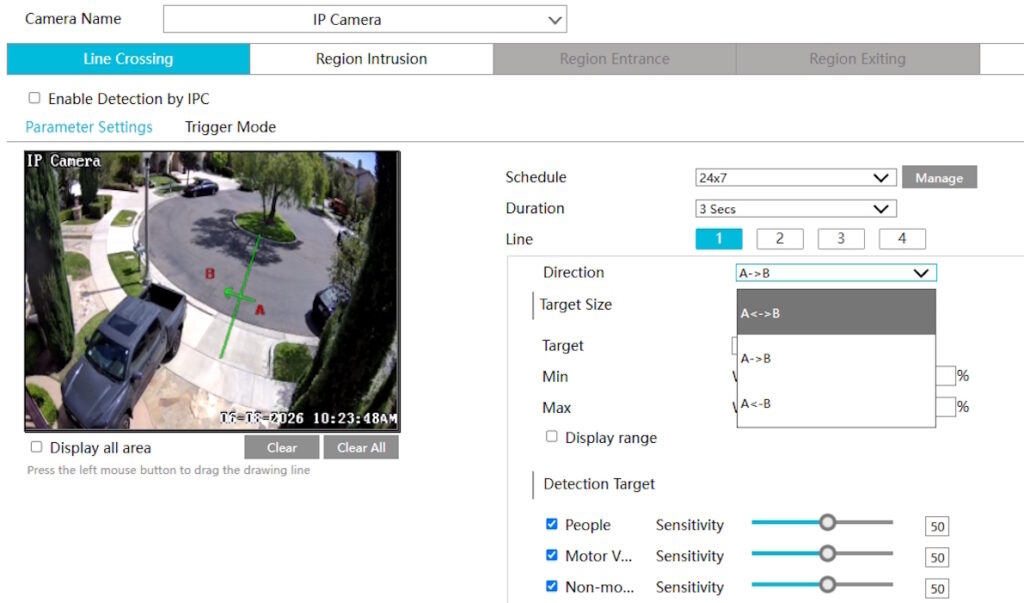
Many facility video monitoring systems come with optional AI capabilities that just need to be configured for the facility’s needs. Depending on the manufacturer, standard commercial cameras come with the following, most of which were discussed in the use cases above:
- Line Crossing – Someone/thing crosses a line that you’ve “drawn” on the camera.
- Intrusion Detection – Someone enters an area that you’ve “boxed off” on the camera.
- Abandon – someone removes something from an area.
- Cover Cam – Someone covers the camera.
More advanced commercial cameras come with more features, including license plate and facial recognition, which were also discussed above.
Every facility has unique operating conditions, and these out-of-the-box AI capabilities have to be configured to make sure they’re providing relevant insight and alerts. A video monitoring partner should be involved in helping you with this configuration process in the beginning as well as adjusting and adding requirements down the road.
Advanced AI Video Configuration
Facilities with in-house AI capabilities – or the desire and budget to work with an outside partner – can take AI video monitoring to a more advanced level. This process involves training a camera system’s built-in AI capabilities ideally using real video data from your facility.
Best practices for advanced AI video monitoring include:
- Clearly defining operational objectives.
- Identifying specific events that require alerts.
- Establishing baseline operating conditions.
- Regularly reviewing false positives and missed detections.
- Retraining or adjusting AI models as facility operations evolve.
With sufficient training, AI systems can be trained to track or alert on a nearly unlimited number of scenarios within a facility.
Challenges of Facility Video AI
AI video monitoring is a powerful tool for facilities, but it doesn’t come without challenges. Here are some of the common ones:
Data Management
Modern facilities generate enormous volumes of video and analytics data. Organizations need clear policies regarding storage, retention, cybersecurity, and access control.
Privacy and Cybersecurity Considerations
Establishing clear governance policies is essential. As AI capabilities become more sophisticated, organizations must ensure they comply with applicable regulations, implement guardrails to keep data secure, and maintain transparency regarding how video analytics are used.
Keep Humans Involved
AI should augment human decision-making, not replace it entirely. The most successful facilities use AI as an operational support tool that helps personnel focus attention where it is needed most while maintaining human oversight of critical decisions.
The AI Video Monitoring Opportunity
Facility management is becoming increasingly data-driven, and video systems are part of that transformation. For facility managers, the opportunity is significant. AI can help organizations improve safety, reduce downtime, optimize operations, and so much more.
The facilities that benefit most will be organizations that clearly define their objectives, focus on solving real operational problems, and use AI-generated insights to support better decisions.
AI video monitoring is one of many technologies contributing to smarter facilities that help teams see problems sooner, respond faster, and operate more effectively.
Heidi Schmidt is Global Sales Manager at Opticom Tech. Heidi has worked in the video technology space for more than 20 years, building expertise in CCTV, industrial video applications, new product development, video network solutions, and more. As a sales leader at Opticom Tech, she helps customers implement robust video monitoring solutions for unique and harsh industrial environments.