A Cooling Tower With a Chronic Condition
At the Corewell Health Service Center, the organization’s mission centers on healing and restoring health. But one critical piece of infrastructure had developed a chronic condition of its own: the cooling tower serving the facility’s air-conditioning system was deteriorating from corrosion and leaks, leading the facility team to rethink the traditional replacement approach.
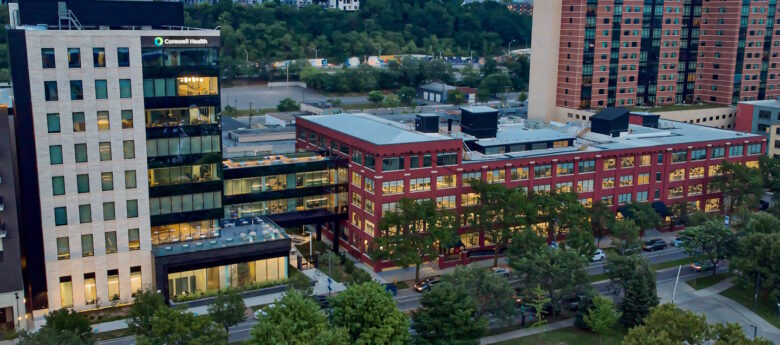
At the Corewell Health Service Center in Southfield, Michigan, just outside Detroit, the organization’s mission revolves around healing and restoring health. However, one critical piece of building infrastructure had developed a chronic condition of its own. The cooling tower serving the facility’s air-conditioning system was deteriorating from corrosion and leaks, forcing the facility team to rethink the traditional approach to cooling tower replacement.
Rather than simply installing another metal-clad tower similar to the one that was now failing, the team began evaluating alternative cooling towers designed to eliminate the corrosion and maintenance challenges that had become increasingly difficult to manage.
The galvanized metal tower supporting the facility’s chiller system had operated for nearly a decade, helping keep the five-story, 680,000-square-foot complex cool and comfortable. Eventually, corrosion began spreading through key structural areas and leaks started appearing throughout the tower. Maintenance crews spent several years trying to keep the unit operating through a series of patchwork repairs, but the problems kept returning.
“The entire bottom of the unit had been pretty well rotted out,” says Brian Mortz Jr., owner of Mechanical Services LLC, the contractor that handled the replacement. “Over the years, they tried numerous times to cover the holes with different sealants, but once you address one section of the tower, another area would start rusting out.”
Persistent leaks created more than a maintenance headache. Water loss increased makeup demand, while expensive treatment chemicals meant to protect the condenser loop were leaking out onto the building’s roof.
Replacing Metal With Engineered Plastic
Eventually, the patchwork repairs stopped buying time. By 2023, the facility team recognized the cycle could not continue. After evaluating several replacement options, the team selected a cooling tower constructed from engineered plastic, high-density polyethylene (HDPE). The new tower replaced a similarly sized dual-cell unit that had previously served one wing of the building’s cooling system.
Unlike traditional galvanized steel towers, HDPE does not corrode when exposed to mineral-rich water, treatment chemicals, or harsh seasonal conditions. That material difference was one of the primary reasons the facility chose the alternative design.
During the evaluation process, the project team collaborated with Access Michigan. The regional HVAC equipment representative reviewed system requirements with the facility team and developed the engineering drawings for the replacement tower.
Alex Collins, a sales engineer with Access Michigan who supported the project, said the conditions that affect cooling towers in the Midwest often accelerate deterioration in traditional metal designs.
“Michigan does not have the best water quality when it comes to minerals,” explains Collins. “Every time you drain and refill a system, you’re introducing new minerals back into the tower. Over time, that can start to eat away at metal components.”
Seasonal temperature swings can further accelerate that deterioration. Cooling towers used primarily for comfort cooling are often drained during winter months and restarted each spring. Repeated exposure to mineral-heavy water combined with freeze-thaw cycles can gradually shorten the lifespan of galvanized metal structures.
For facilities operating in climates like Michigan, Collins said engineered plastic towers offer an alternative approach designed to eliminate those corrosion risks.
Water and Chemical Savings
Ultimately, the facility selected a 300-ton TM Series cooling tower manufactured by Delta Cooling Towers, the company that pioneered HDPE cooling tower technology in the 1970s.
Since installing the replacement tower, the facility has seen immediate operational improvements. Eliminating the persistent leaks significantly reduced the amount of makeup water required to keep the system operating while also stabilizing the building’s chemical treatment program.
Instead of losing treatment chemicals through the tower structure, the system can now maintain proper water chemistry inside the condenser loop where it belongs. For facility teams managing large HVAC systems, maintaining that balance is critical to protecting pumps, heat exchangers, and other downstream equipment.
One of the most important design differences between the new tower and the previous unit is the construction of the outer shell.
Traditional metal cooling towers are typically assembled using multiple panels that must be welded or sealed together. Over time, those seams can become vulnerable to corrosion and leaks. The HDPE tower installed at the Corewell facility uses a one-piece molded shell, eliminating many of the joints where leaks commonly occur.
For facility operators accustomed to chasing corrosion and patching seams, the difference is significant.
Reducing Maintenance
The replacement tower also eliminated another common maintenance issue: belt-driven fan systems.
Many traditional cooling towers rely on belt and gearbox assemblies to drive the fan. These systems require regular inspection and adjustment, and worn belts or bearings often become a source of service calls.
“Everybody knows belt-driven components require more maintenance,” adds Collins. “Loose belts, worn bearings, and other mechanical issues can quickly turn into service calls.”
The tower selected for this project uses a direct-drive fan system, removing belts and gearboxes from the design. With fewer moving parts, the system reduces routine maintenance requirements and minimizes potential failure points.
The HDPE construction also reduced the overall tower weight compared to traditional metal structures, simplifying rooftop handling during installation.
Quiet Operation
Noise reduction was another benefit the facility hoped to achieve and one that was quickly noticed after installation.
Cooling towers located near office spaces can produce noticeable mechanical noise, especially when large belt-driven fan systems are involved.
After the new tower was installed, staff inside the building initially questioned whether it was operating.
“They asked if the tower was even running,” says Mortz. “When they went outside to check, everything was working perfectly.”
Faster Replacement
Once the replacement decision was made, the installation moved quickly. The deteriorated tower was lifted out and the new unit installed during a single crane operation. The crane had to reach over a parapet wall roughly 40 feet from the roof edge to remove the aging tower before lowering the new unit into position.
“Any time you’re working inside a parapet wall with limited crane access, planning becomes critical,” explains Mortz. “Once the old tower was removed, the new unit went into place smoothly. Everything lined up the way it was supposed to.”
Due in part to the engineered plastic tower replacement arriving largely preassembled, the installation crew was able to complete the placement and final connections in just one day.
A Different Approach to Cooling Tower Longevity
By eliminating many of the failure points associated with traditional metal construction, materials like HDPE can reduce maintenance demands while improving long-term reliability.
For the Corewell Health facility team, the replacement ultimately delivered what the previous tower could not: reliable operation without the ongoing cycle of corrosion and repair.
For facility engineers facing similar challenges, the project demonstrates how alternative materials can fundamentally change the long-term maintenance equation for cooling towers.