
The Hidden Cost of Return Visits in HVAC Service Businesses
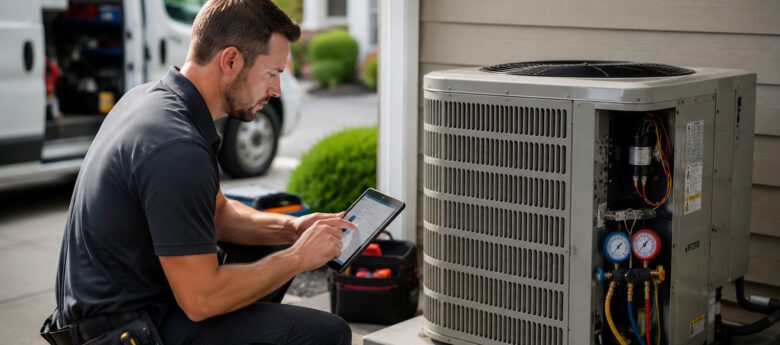
A facility manager in Cleveland told me last spring that his building’s rooftop unit had been “fixed” four times in six weeks before anyone actually solved the problem. Each visit cost his budget somewhere between $450 and $1,000 in truck-roll time alone, according to GridPoint’s analysis of commercial HVAC repair costs, and roughly 25% of commercial HVAC truck rolls require a return visit. The unit itself was fine. The diagnostic process wasn’t. That story is the entire industry in miniature, and it’s the reason I want to talk about return visits as an operational problem, not a technical one.
The Number That Should Keep Facility Managers Up at Night
The industry-average HVAC callback rate sits between 8-12% of completed jobs, with top operators under 3% and the sharpest shops under 2%. The gap between average and the top of the field isn’t skill. It’s process discipline.
A typical residential service callback runs about $650 fully loaded; install callbacks average $850 once you include labor, truck roll, parts, and the lost revenue from the slot the technician couldn’t sell to a new customer. On the commercial side, where I spend most of my conversations, the number is worse because the failed diagnosis often means a building sits without cooling or heat for another 24 to 72 hours while parts get ordered a second time.
Here’s the math nobody wants to write down: a shop running a 5% callback rate on $4 million in install revenue burns roughly $80,000 per year on rework alone, and that’s before you count reputation damage. For a facility manager, the same math flips: every callback on your building is a day you paid twice for the same problem.
Why the Callback Isn’t Really About the Technician
I’ve walked through enough dispatch offices to know that when a callback happens, the first instinct is to blame the tech who took the original call. Sometimes that’s right. Usually it isn’t. The industry-average first-time fix rate is 70-80%, and the gap between that and the top performers shows up almost entirely in three places:
- Intake quality. The dispatcher didn’t get enough information from the caller to route the right tech with the right parts.
- Work order detail. The previous visit’s notes were on paper, in a truck, or in someone’s head, so the current tech starts blind.
- Parts prep. The tech arrived without the specific component the symptom pattern predicted.
None of those are technician problems. They’re information problems. A failed first visit typically generates an average of 2 additional dispatches and extends resolution time by 14 days, so the compounding effect is brutal. You aren’t losing one visit. You’re losing three visits and two weeks of goodwill.
Across our customer base, HVAC contractors who switch from paperwork orders to mobile-first dispatch typically see their first measurable gains in same-day job completion within the first 60-90 days, with the largest jump showing up in maintenance call volume rather than installs. That order matters. Maintenance is where sloppy documentation from a prior visit turns into a callback three months later, when a different tech arrives with no context.
The Capacity Trap Facility Managers Rarely See
When a contractor is running at capacity (which most are, especially during the peak season Samsara documented across 65 million HVAC service trips from September 2023 to June 2025), a callback doesn’t just cost the return visit. It cancels a paying job somewhere else on the board.
Good scheduling practice reserves about 20% of daily capacity for emergencies with 15–30-minute buffers between jobs. Callbacks eat those buffers first. Once the buffer is gone, every job after 10am runs late, techs skip lunch, quality drops, and the next callback is already being manufactured. This is the loop I’ve watched destroy otherwise well-run shops.
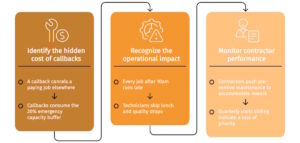
For a facility manager, the tell is when your contractor starts pushing your preventive maintenance visits to accommodate their own rework. If your quarterly PM keeps sliding by two weeks, you’re not their priority anymore, their callbacks are.
What Actually Moves the Number
I’ll be direct about what I’ve seen work, and I’ll cite specifics rather than platitudes.
Structured intake questions – A dispatcher who asks eight scripted questions about symptom, unit age, model number, error codes, and access constraints will send a tech with the right parts far more often than one who takes a two-minute call. This is a training problem, not a software problem, though software makes the script hard to skip.
Digital work orders with photos – When the previous tech’s notes and photos are available on the current tech’s phone before he leaves the yard, callback root causes get spotted at the shop instead of on-site. Contractors using field-service management platforms report meaningfully higher first-time fix rates and fewer callbacks, and the mechanism is almost always documentation continuity, not any single feature.
Job costing at the individual tech level – Most operators report that the single most-overlooked feature in their first year is the dashboard view: shops that build a habit of checking weekly job count, revenue per tech, and aging receivables tend to catch problems before they become quarterly surprises. Callbacks concentrate. The most expensive callback category, the 30-day install warranty return, is typically concentrated on 2-3 technicians per shop. If you don’t measure by tech, you can’t see it.
Recurring maintenance discipline – In our customer base, HVAC and pool service shops with strong recurring maintenance programs treat notifications less as a marketing tool and more as an operational backbone. Appointment reminders alone reduce no-show rework noticeably for both verticals. For facility managers, the same principle applies in reverse: a contractor who runs a real PM program has fewer emergency callouts and therefore more capacity to serve you well.
The Customer-Side Cost Nobody Prices In
Callbacks don’t just cost the contractor. They cost the building relationship. Demand-only HVAC customers retain at 40-60% on their second job, while maintenance-plan members retain at 80-90%, and the fastest way to drop a maintenance customer off that curve is to show up twice for the same problem.
The behavioral research is consistent. 69% of customers hire an HVAC company they’ve used before or that was recommended, which cuts both ways: a good relationship compounds, and a bad one gets discussed at every regional facilities meeting for the next two years. I’ve had facility managers tell me they’ll pay 15% more per invoice to work with a contractor who doesn’t come back twice.
What I’d Ask My Own Contractor
If I were sitting on the facility side of the table right now, three questions would tell me almost everything I need to know about whether my contractor has a callback problem:
- What’s your first-time fix rate, measured how, over what period?
- Can I see the work order and photos from my last three service visits?
- How do you assign techs to my building, and does the same person come back when there’s a follow-up?
A contractor with clean answers to those three questions is running a real operation. A contractor who deflects is going to cost you money you haven’t budgeted for yet.
An Operator Takeaway
Return visits are not a technician quality problem, they’re an information continuity problem, and the shops that treat them that way pull ahead of the average within a quarter. If you manage a building, the callback rate of your HVAC vendor is a leading indicator of every other cost line in your maintenance budget. Ask the question this month. The answer will tell you whether next year’s numbers are already written.
Joy Gomez is an engineer, process automation expert, and the Founder of Field Promax. Known for his technical expertise and commitment to field service innovation, Joy writes about transforming traditional business models into paperless, efficient operations. He is a Lean Six Sigma Black Belt based in Rochester, MN, dedicated to helping field professionals work smarter through better technology. Connect with him on LinkedIn.