
Radiant Heating & Cooling for Sustainable Commercial IEQ
With sustainability and indoor environmental quality (IEQ) shifting from emerging trends to baseline expectations, the industry is continuing to seek heating and cooling technologies that are efficient, effective, and easy to maintain for commercial structures.
To meet these demands, one technology is gaining interest from building owners, facility managers, engineers, contractors, and end users. It’s radiant heating and cooling.
While the concept has been around for more than a thousand years (dating all the way back to Roman times), modern radiant heating and cooling is becoming a prominent technology for providing sustainability and IEQ in large-scale projects.
From hospitality high rises and healthcare buildings to educational institutions, corporate office spaces, and even data centers – which are heavily trending with the meteoric rise of artificial intelligence (AI) – radiant heating and cooling is a real solution to manage indoor climate while promoting sustainability, IEQ, and low maintenance.
Sustainability & Energy Efficiency
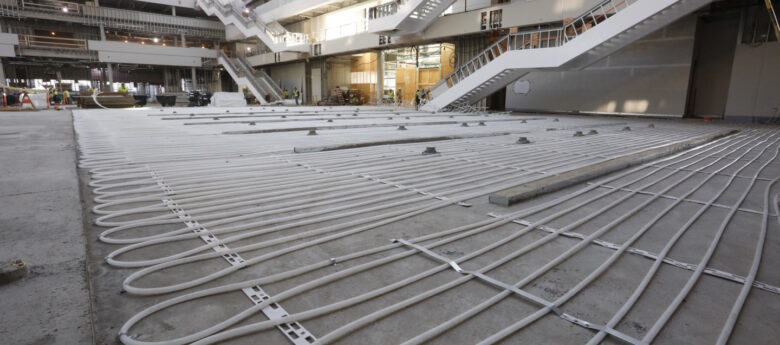
In a hydronic radiant heating and cooling system, heating hot water or chilled water circulates through embedded pipes in floors. Depending on the application need, this technology can work in walls or ceilings as well.
When the system is in heating mode, the water flowing through the piping system warms the surface of the floor, wall, or ceiling to radiate warmth into the area. The inverse happens in cooling mode, absorbing heat from a space.
Because water has the capacity to transport energy 3,500 times greater than air, a hydronic-based radiant heating and cooling system is significantly more energy efficient than a traditional forced-air HVAC system.
In addition, most people are more comfortable with radiant heating at a lower thermostat setting, such as 68°F, than with forced-air heat at a higher thermostat setting, such as 72°F. This is also true for radiant cooling at 78°F as opposed to forced-air cooling at 72°F. That several-degree adjustment can make a big difference in energy use.
Adding to those benefits, the high-temperature cooling concept used with radiant cooling and radiant ceiling panels can reduce the load on equipment, allowing for smaller-sized heat pumps that do not consume as much electricity.
Hydronic radiant systems also work really well with sustainable heating and cooling sources. In fact, there are significant energy advantages combining radiant systems with geothermal ground source heat pumps (GSHPs).
Geothermal systems regularly achieve COPs (Coefficient of Performance) of 3 to 5 or higher, making them significantly more efficient than conventional HVAC systems. For example, in a heating application, a closed-loop geothermal system can actually provide free heat, because it recharges the ground. For cooling, a typical chilled water system recirculates at 42°F, and radiant cooling systems operate at 58°F. Each degree the supply water increases can save between 1.5% to 3% in energy, which helps lower greenhouse gas emissions.
Low Maintenance
Properly designed and installed radiant systems can last for decades and require very little maintenance. They don’t need air filter replacements, furnace tuneups, etc., that are necessary with traditional forced-air HVAC systems.
The PEX pipe in a hydronic radiant heating and cooling system does not pit, scale, or corrode. This durable polymer piping product is designed and manufactured to last the life of the structure, and some PEX manufacturers offer a warranty on the pipe for up to 25 years to promote added confidence and peace of mind.
Another benefit of PEX is its carbon footprint. Studies indicate that the carbon footprint of PEX is lower than copper when considering material extraction, processing, and installation. According to the Journal of Cleaner Production, “…energy and global warming potential reductions for PEX piping compared to copper piping (average for copper pipes types K, L and M) are 44% and 64%.”
Comfort
Radiant most closely aligns with the ideal heating curve for the human body. This means people are most comfortable with a radiant heating system than any other form of heating a space. Plus, when the system is in the floor where people are located, it provides instant comfort instead of wasted energy up in the ceilings (for heat, specifically).
Forced-air heating systems, on the other hand, are the most divergent from the ideal heating curve for the human body. That means people are least comfortable with forced air.
Also, because radiant systems deliver an even comfort that reaches every area of a space, there are no hot or cold spots like with forced-air systems. With a radiant system, there is a consistent, even comfort at all times.
Air & Sound Quality
Since hydronic radiant heating systems use pumps to move water instead of fans or blowers to push air, the system does not circulate dust or allergens throughout a space. In addition, radiant does not circulate odors, adding to improved air quality.
Radiant is also a quiet system. The various parts, including manifolds, actuators, pumps, and boilers, all work relatively silently.
Another benefit of radiant systems pertains to architectural design. Since these systems don’t require ductwork, they allow freedom from bulkheads and floor vents.
Applications
There are various applications available for commercial radiant heating and cooling systems, including wire ties, staples, PEX rails, or prefabricated rollout mats.
Wire ties affix the PEX pipe to the wire mesh or rebar (typically every three feet) to ensure the pipe stays in place as the concrete is poured over the pipe and wire mesh or rebar grid system.
Plastic staples go around the outside of the pipe (not through it) and then adhere to a foam insulation laid over a concrete slab.
PEX rails are long pieces of plastic, nylon or metal that feature “channels” to hold the PEX pipe at a consistent spacing distance. Typically used in structural and non-structural concrete slabs, PEX rails can be fastened to almost any surface, including wood, foam board insulation, and concrete.
Rollout mats are ideal for large, open-space buildings. These custom designed, prefabricated, pre-pressurized mats quickly and easily unroll to install a radiant system in a fraction of the time it takes for traditional methods.
Visit radiantprofessionalsalliance.org, heatinghelp.com, or uponor.com to learn more about radiant heating and cooling application and design.
Kim Bliss is the technical and marketing content manager at GF Building Flow Solutions. She can be reached at .