
Growth and Sustainability With Ultra-Low & Nano-NOx Burners
Environmental regulations continue to evolve and tighten around NOx emissions. In parts of Northeast and Southern California, sub-9 ppm NOx combustion for natural gas has already become the practical standard, while states like Maryland have proposed phased adoption of near-zero-NOx systems for institutional boilers by 2029. A facility’s emissions profile now directly influences whether it can renew operating permits, add capacity, or modify equipment without triggering additional controls or regulatory review.
At the same time, the global combustion market is shifting. The NOx control equipment sector is projected to reach $7.3B by 2030. Next-generation burner technologies (Low-NOx and Nano-NOx burner platforms) are driving a lot of that growth. These burners reduce NOx formation in the flame itself rather than relying on downstream Selective Catalytic Reduction (SCR) systems that remove NOx from boiler exhaust flue gases. They achieve this by reducing peak flame temperature, stabilizing combustion across load swings, and preserving efficiency without sacrificing reliability.
For many facilities, especially hospitals, universities, district energy plants, and industrial processing sites, the burner is a key factor in a plant’s long-term sustainability. Many of these facilities face aging boilers and heaters but aren’t equipped with low-NOx or Ultra Low-NOx burner technology and supported systems, such as flue gas recirculation (FGR) and economizers (heat exchangers), which play important roles in efficiency and emission reduction. The economizer reduces flue gas temperature, making FGR integration more feasible. On a typical water-tube boiler application, the economizer outlet flue gas temperature ranges from 300°F to 325°F; without an economizer, flue gas temperatures may exceed 600°F which significantly complicates retrofits. Higher flue gas temperatures reduce air density, which requires larger FD fans, higher volumetric flow, and increased FGR duct sizing, all of which have an impact on burner tuning and system design. Therefore, the implementation of economizers with low NOx & Ultra-low-NOx burners must go hand to hand.
Controls are also a critical factor in achieving Low-NOx and Ultra-Low-NOx performance. The Burner Management System (BMS), regardless of whether it has micro-processor-based controls or programmable logic controllers (PLCs), does not change significantly between Low-NOx and Ultra-Low-NOx systems, as similar safety instrumentation is required. The combustion control system (CCS), however, has more effect on performance. CCS platforms may be pre-configured controllers or fully programmable PLC-based systems. They manage multiple control loops and are responsible for regulating and monitoring fuel and air ratios, FD fan dampers, FGR dampers, draft dampers, fuel valves, fuel flowmeters, stack O₂ levels, furnace pressure, and more.
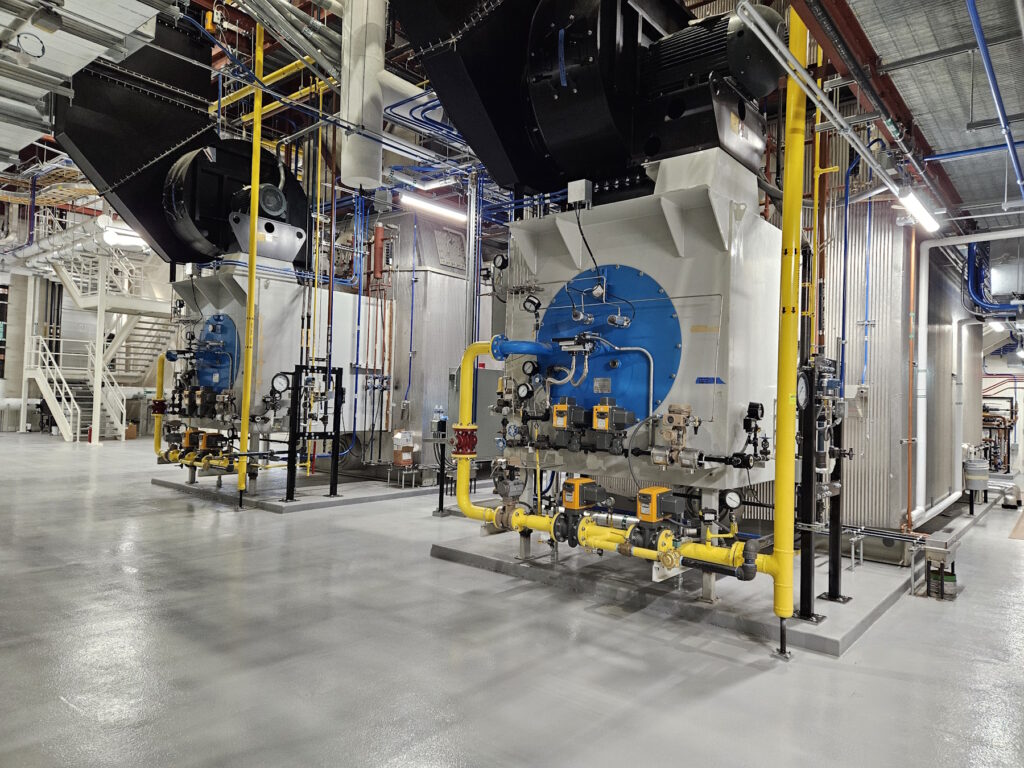
Finally, water-tube boilers themselves have improved substantially over time. Many packaged water-tube boilers (still in operation) were built before the 1960s, at which time they were designed with refractory on the furnace walls (front, floor, ceiling, rear), depending on the furnace configuration (D-type, O-type, A-type). Refractory retains heat, protects furnace tubes from high temperatures, and shields them from chemical attack caused by combustion byproducts such as CO, water vapor, and sulfur compounds. Unfortunately, this method is far less efficient than modern water-tube boilers, which are more compact and use membrane-wall construction with minimal or no refractory. The benefits are higher efficiency, faster heat transfer through furnace tubes, and improved flame quenching, all of which help reduce NOx and reduce the risk of combustion product leakage that could elevate CO.
Because of all these factors with burners, controls, and boilers, many end-users will soon face the decision between installing a completely new boiler system or retrofitting their existing unit with a new burner and updated control system.
Case Studies From the Field
A few recent installations have highlighted the variety of methods that can be used to lower NOx emissions.
At a major Massachusetts institution, the site required high-capacity, dual-fuel operation within a constrained boiler room footprint. A Preferred NanoNOx burner system was engineered to operate at 78 MMBtu/hr firing natural gas and ULSD, delivering 9 ppm NOx at 3% O₂ on gas and 0.08 lb/MMBtu NOx with Flue Gas Recirculation (FGR) on ULSD. The system met emissions performance without the need for SCR, preserving reliability and allowing the facility to meet tightening rules without additional infrastructure.
In another project, four Preferred NanoNOx burners were supplied to an LNG facility, each firing at 84 MMBtu/hr. The combined heat input on these watertube boilers was 336MMBtu/hr. The burners achieved a guaranteed 9 ppm NOx at commissioning, eliminating uncertainty in the permitting process and allowing the site to maintain performance at scale. In systems of this size, consistency of combustion and stability under load are just as important as emissions. The burners delivered both.
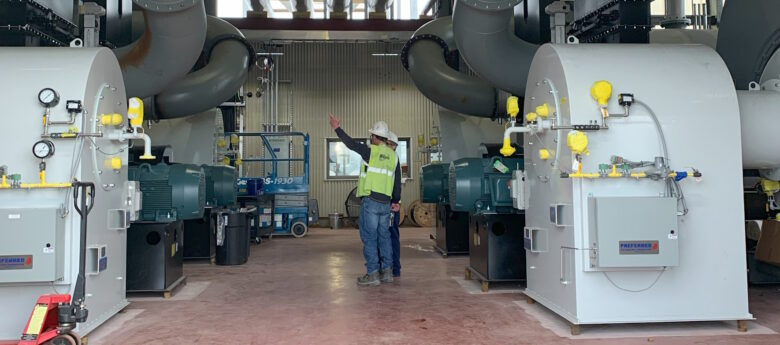
Healthcare facilities face particularly stringent reliability expectations, and a recent boiler room upgrade at Abbott Northwestern Hospital demonstrated what this looks like in a real-world application. The two watertube boilers (rated for 80,000 and 60,000 lb/hr of steam generation, respectively) operated at 9 ppm NOx on both gas and oil and passed their source test. Both boilers are equipped with NanoNOx burners and achieved stable performance during commissioning, guaranteeing the hospital’s ability to maintain uninterrupted operation. The project was showcased during the Women in the Boiler Industry (WIBI) tour this past October 2025 in Minneapolis, where operators and engineers saw the system running in real-world conditions.
Preparing for the Future
Low NOx and NanoNOx burners are no longer simply emissions-reduction tools. They are systems that:
- Protect the facility’s ability to maintain and renew operating permits.
- Keep future expansion pathways open.
- Support transitions toward renewable and alternative fuels.
- Improve fuel efficiency and combustion stability across the firing range.
As regulatory expectations evolve, the facilities best prepared for the next decade will be those that adopt burner technology designed not only to meet today’s requirements but to remain practical for tomorrow as well.
Dennis Garcia is Director of Sales & Business Development at Preferred Utilities Manufacturing Corporation. Preferred Utilities Manufacturing Corporation supports our customers’ preparedness for current and future regulations. We help them adopt burner technology that is both flexible and efficient, so they are able to meet the challenges to come.